 |
|
SKAGIT BICYCLE CLUB NEWSLETTER
Saddle Post Intelligencer
November 2026
|
|
Please note: there will not be a December newsletter. The next newsletter will go out on January 1, 2027.
|
|
|
|
|
President's Report
By Barry Antler
Last month the Skagit Bicycle Club hosted Dan Shryock, a travel writer and career journalist who focuses on cycle tourism, on a couple of our rides. He's based in Oregon; his work has appeared in magazines and websites in California and the Pacific Northwest. Dan is currently writing about his Skagit Bicycle Club experience and hopes to post it on his Substack site any day now. Follow the link to his site to find the article and/or read some of his other well-written bicycle-related articles in "Why We Ride": danshryock.substack.com
The one that caught my eye was Why Some Bike Trips Stay with You Forever. You'll find it in Cycling News below.
Dan recently helped arrange a Zoom call between the Salem Bicycle Club's Ride Leader Committee and some of the members from our club's committee. We were able to pick their brains about how they organize and facilitate their rides. Our committee met in mid-October and is excited about employing some of the concepts we discussed at that meeting, and what we gleaned from the SBC.
|
|
|
SBC's 2026 Annual Meeting Notes
Thank you to everyone who showed up on October 7th for the Skagit Bicycle Club's annual meeting held at the Mount Vernon Library/Commons. Just over 60 members came out for the event. After a delicious meal catered by Shawn O'Donnell's we were honored to have a book reading presentation by Anita Elder, who read from her book, Finding Freedom on Two Wheels: How Two E-Bikes Helped Me Reclaim My Health, Confidence, and Sense of Adventure. I found her presentation truly inspirational and the book was next to impossible to put down! If you weren't one of the lucky members that found a voucher for her book under your seat, you can order a copy on Amazon (it's also available as a book on tape).
Officers and board for 2027
Elections were held for the open Officers and Board Members seats for 2027. The following members were voted in by the membership that was present that evening:
- Past President 2026: Barry Antler
- President: Steve Moe
- Vice President: At present we do not have a candidate for vice president. If you have the time, skills, or interest in contributing, we'd love to hear from you.
- Treasurer: John Laudermilk
- Secretary: Jack Eisaman
- Board Members: Jacqui Ilman, Lynnet Tomaso, Jennifer Streng-Roberts
Thank you for volunteering to give back to the cycling community and helping to shape the future of the club.
Where the club's donations went
We also had a brief treasurer's report. Here's a recap of where the club pledged and donated funding to date this year:
- Adaptive bikes: Over the past two years SBC purchased three adaptive bikes for the Mount Vernon School District and one for the Burlington-Edison School District. This year we purchased a small one for Mount Vernon.
- Anacortes Fire Department Bike Helmet Program, $500: To reduce head injuries from bicycle and skateboarding accidents, AFD provides helmets, free of charge, to members of the community who do not have one. The program is supported and funded by local service groups. To obtain a free bicycle helmet, accompany your child to the Fire Department at 1016 13th Street, where one of the Firefighter/Paramedics will properly fit your child with a helmet.
- Guemes Island Ferry Trail, $1,500: Funding for Phase I and Phase II of a trail that gives bikers and walk-on passengers a measure of safety when arriving at the island's ferry dock. It will run about 1.5 miles along Guemes Island Road from the ferry dock to Edens Road and Schoolhouse Park.
- Centennial Trail Phase I, $10,000: Skagit PUD partnered with Skagit County Parks and Recreation to create a 2.5-mile multi-use trail built directly on top of a Skagit PUD water transmission pipeline. The initial phase, the Nookachamps/Centennial Trail, follows an abandoned railroad corridor parallel to State Route 9 and will link Clear Lake Beach Park southward to a new trailhead and parking facility just north of the Big Rock roundabout (near SR-538 and SR-9). Plans include a 10-foot-wide paved surface for cyclists and pedestrians alongside a 6-foot-wide unpaved section for equestrian use, plus a Highway 9 pedestrian crossing with flashing safety lights. Construction is anticipated to begin in 2027 or 2028 once full funding and final design approvals are secured.
Awards and recognition
Steve Jahn was presented with a plaque recognizing his leadership and long-term contributions to the Skagit Bicycle Club. The plaque reads: "In grateful recognition of your leadership and long-term contributions to the Skagit Bicycle Club — 2002 through 2026." Thank you, Steve!
Steve Moe gave a brief talk about the Rider Participation Initiative and Increasing Ridership. Thank you, Steve, for your dedication and for the work you've put into helping the club offer and lead a strong lineup of rides throughout the year.
Rod Lee won the $150 COA Mexican Restaurant gift certificate awarded to the member who completed the most rides between May and September.
We recognized the six ride leaders who led the greatest number of rides this year: John Yaeger (33), Jannette Folkertsma (21), Phil McCloud (18), Steve Moe (17), Barry Antler (5) and Rose Ploeg (4). Honorable mentions went to Jim Houston, Rod Lee, Steve Jahn, Kieth Eilers, John Laudermilk, Chuck Lemay, Barry Crestenson and Dave Lucas. Thank you for your commitment, your consistency, and the energy you bring to one of the most important parts of our club's mission. Your leadership keeps our community rolling strong.
John Laudermilk took home a $50 gift certificate from Skagit Cycle Center for this year's Best Safety Tip: "Ride a straight line. Try not to wobble or move side to side. Other riders in the group can anticipate much better when you ride a straight line. I visualize myself attached to the back of a pace car and try to ride in a 'still' position."
Don't forget that Skagit Cycle Center gives SBC members a 10% discount on bicycle repairs and gear. The discount does not apply to the purchase of bicycles.
|
|
|
Why Some Bike Trips Stay with You Forever
By Dan Shryock
Transformational travel experiences turn miles into cycling memories.
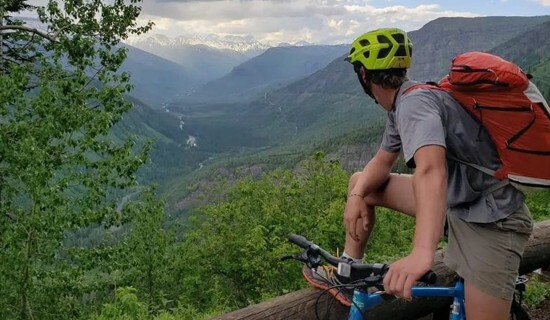
A view from the Going-to-the-Sun Road in Glacier National Park / © Dan Shryock photo
Have you ever stopped during a bike ride to simply look around and appreciate your surroundings?
Have you ever felt exhilarated after conquering a climb, realizing you could do more on a bike than you ever thought possible?
Have you ever been deeply moved by a cycling experience?
I was listening to Jake Haupert, an expert on a concept called transformational travel, during a recent writers' conference when I paused to consider whether this "Why We Ride" platform has sometimes drifted from a basic tenet. While delivering information about cycling destinations – where to ride, how to get there, and the experience waiting there – I've on occasion overlooked the why.
Jake's conference talk, titled "The Next Story of Place," immediately hit home. Jake founded the Transformational Travel Institute, a non-profit group that works with destinations to develop visitor experiences that, as the name says, transform vacations into memorable personal experiences.
"Think of a place that stayed with you," he asked his audience of writers and tourism managers.
Thoughts rushed past me like a 40-mph descent.
Lucca, Italy. England's Lake District. Victoria, British Columbia. Glacier National Park. Crater Lake National Park. The Columbia River Gorge.
I jotted these down and kept going.
California's Mt. Tamalpais. Oregon's McKenzie Pass. Washington's Walla Walla wine country.
Each trip stayed with me for a different reason. Accomplishment. Culture. Scenic beauty. A shared experience. It didn't matter; I have never forgotten any of them.
Jake, like us, loves riding his bike. That evening, I asked him how transformational travel applies to cycling.
"Cycling opens you up to being more present and aware," Jake quickly said. "It opens you up to connect with others that you might be cycling with. Those things create the conditions for people to find a little bit more connection and sense of purpose and meaning.
"And, of course, there's a physical challenge as well," he continued. "Having that opportunity to push yourself to limits and see what you're capable of. It's one thing to just go and do it, but it's another to reflect on it."
Here's something I wrote 10 years ago.
"Cycling is not the reason to travel. The bicycle is the vehicle by which we are exposed to new places and cultures. Whether you are 200 or 2,000 miles from your home, there is plenty to discover and learn while riding a bike."
I might edit those words. Certainly, the ride is reason enough to travel. Bundle that with where you are, who you're riding with, and what you see, and the full experience is a marvel.
Transformational travel is meaningful when carried forward. It's something that endures days, months, even years later. It becomes personal.
I once climbed the western slope of the Going-to-the-Sun Road in Montana's Glacier National Park. I didn't think I could pedal uphill for 16 miles to Logan Pass, but I made it to the summit. It changed my perception of my own capabilities.
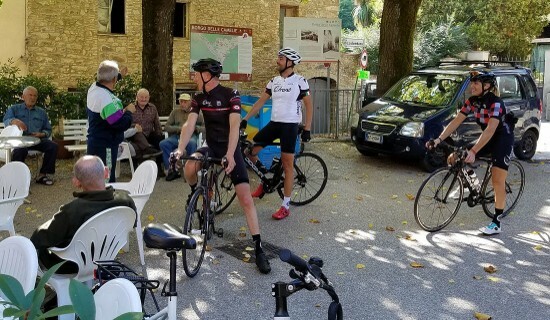
A ride around Lucca, Italy, with Paladino Meschi, center in a black kit, includes stops to talk with his longtime friends / © Dan Shryock photo
I rode on narrow backroads outside Lucca with Paladino Meschi, owner of Chronò Bikes. We weaved along hillsides overlooking the Serchio River Valley in northern Tuscany, paths likely known only by locals, and eventually stopped for a caffè doppio at a quiet, rural coffee bar. I was not a tourist. I was riding with a friend while speaking my best Italian; in that moment I was a local.
Our cycling group has roamed throughout California, the Pacific Northwest, and British Columbia. We've endured 100-degree temperatures and flooded roads, spent hours on bike saddles and even more hours driving on interstates to get there. We've grown as a group through our shared experiences. We've connected.
When we ride, we feel the alternating warm and cool air as we pass through microclimates. Our legs adapt to undulating terrain and we hear the wind's effect on hustling leaves in nearby trees. It combines to paint a mental landscape.
I once stopped along a country road outside Solvang, Calif., to simply look at vineyards rolling like leafy green blankets up hillsides. Victoria de Onis, a group member, coasted in behind me and together we stood astride our bikes and simply appreciated where we were and how we got there.
Jake is right. A cycling trip is not simply about pedaling from point A to point B. It's about what you discover along the way. So, think of a place that stayed with you long after your cycling trip ended and answer these questions:
Have you ever stopped during a bike ride to simply look around and appreciate your surroundings?
Have you ever felt exhilarated after conquering a route, realizing you could do more on a bike than you ever thought possible?
Have you ever been deeply moved by a cycling experience?
How were you transformed while on a bike? Tell me about it. Email me at dan@danshryock.com.
*Reprinted from Why We Ride: The Destination Cycling Guide, a reader-supported publication at danshryock.substack.com*

Dan Shryock's book, Cycling Across Oregon: Stories, Surprises & Revelations Along the State's Scenic Bikeways, is available on Amazon.
|
|
|
The Pressure to Perform
By Mark Proulx
Sources for this article are listed in note 1 at the end.
Introduction
In cycling, the human desire to accomplish something with the least effort expresses itself in many ways. Weight reduction. Aerodynamic designs. Smoother drivetrains. Prominent among these is wheel technology. The goals here are reduced rotating mass, rolling resistance, aerodynamic drag, and hub friction. To this end, lightweight aluminum or carbon rims, often with deep sections, have migrated from the professional arena to the consumer world. Low-friction hubs have also become mainstream.
Tire and tube technologies have also evolved. For decades, narrow tires, inflated to high pressures, ruled the day. Butyl rubber inner tubes were the standard, with hard-core riders opting for latex to shave weight and decrease rolling resistance. Today's tires have significantly less rolling resistance than their predecessors. Many riders have abandoned inner tubes altogether, opting for a tubeless setup. Those who don't want to deal with the hassle of tubeless tires may opt for TPU tubes, which reduce rolling resistance almost to the extent of tubeless tires.
While all of these technologies get the spotlight and eagerly drain your bank account, one important component is absolutely free, yet frequently neglected.
The air.
You can have too much of a good thing
For what seems like forever, conventional wisdom held that for road riding, tire pressure and rolling resistance were inversely correlated, i.e., higher pressure meant easier rolling. This belief was reinforced by intuition (try riding on soft tires!) and results from instrumented tests conducted by rolling wheel sets against smooth steel drums.
About 20 years ago, however, field observations revealed something odd – competitive road racers were posting faster speeds with lower pressures. These observations prompted numerous organizations to investigate this behavior in a structured way. Their findings have been consistent and unequivocal – increasing the pressure helps to a point, then rapidly introduces a significant penalty through increased rolling resistance.
This phenomenon is shown in Figure 1, a plot of the Coefficient of Rolling Resistance (Crr)[2] versus tire pressure for a 700x23 Vittoria KS tire fitted with a latex tube.[3] The smooth curve represents the theoretical performance. The darker blue dotted curve depicts measurements taken while rolling against a steel drum. The lighter blue dotted curve shows what happens when the tire rolls on asphalt. Note that at pressures lower than about 117 psi, there is no difference in performance. At higher pressures, when rolling on asphalt, the rolling resistance increases dramatically.
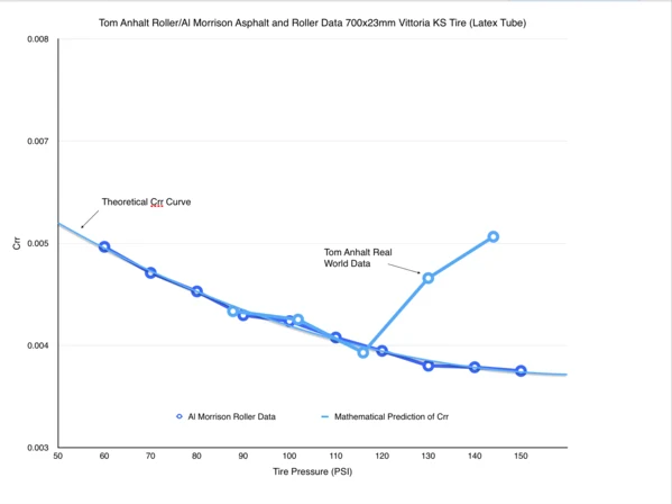
Figure 1: Coefficient of Rolling Resistance vs. Tire Pressure. Source: Rolling Resistance (The History and Previous Works), Marginal Gains Media.
Why does this happen? As noted earlier, a severely under-inflated tire channels the rider's energy into continually deforming the tire and tube – an inelastic, "mushy" system that makes the rider feel as though they're "riding through goo." When the rider increases the pressure, the system becomes more elastic. In this regime, small surface imperfections – chipseal, stones, pavement cracks, etc. – initially deform the tire, causing it to act like a spring to store energy. When the tire passes the disturbance, the "spring" releases, dumping its stored energy back into the forward motion of the bike.
If the rider increases the pressure too much, however, the tire/tube system, while still elastic, becomes too stiff to deform meaningfully during the brief period when the disturbance is encountered. Instead, the disturbance lifts, then drops the bike and rider. When this happens, the energy expended by lifting and dropping the bike is perceived by the rider as "roughness" or "harshness." It is dissipated in the rider's body via internal friction and is no longer available to propel the bike forward, a phenomenon referred to as suspension loss. The point at which this occurs is the pronounced kink shown in Figure 1. At pressures higher than this value, the suspension losses overwhelm the benefit of increased pressure, leading to a rapid increase in rolling resistance and thus riding effort.
Getting it right
The goal, therefore, is to set the tire pressure just below this transitional value. This is easy to do because Silca has created a tool – the Silca Pro Tire Pressure Calculator – that anyone can use at no cost to find the desired value.[4] The calculator comprises a web page with drop-down selections for seven variables:
- Total system weight (rider, bike, and gear), in lbf or kg
- Riding surface condition: track (indoor wood), track (outdoor concrete), new pavement, worn pavement with some cracks, Category 1 gravel, poor pavement/chipseal, Category 2 gravel, cobblestone, Category 3 gravel, Category 4 gravel
- Measured tire width: 20 mm – 65 mm
- Wheel diameter: 700C/29", 650C, 650B/27.5", 26"
- Tire type: Silca race casing; high-performance tire, tubeless or latex tube; mid-range casing, tubeless or latex tube; mid-range casing, butyl tube; puncture-resistant tire, tubeless or latex tube
- Average speed: recreational, fast single track, moderate group ride, fast group ride, Category 1/2/3 racing, pro tour
- Weight distribution (% front/rear): 50/50 (triathlon/time-trial/track bike), 48/52 (road bike), 47/53 (gravel bike), 46.5/53.5 (mountain bike)
The calculator generates separate values for the rear and front tires. These values are not meant to be the final answers. They should be treated as a starting point to be refined through experience.
Everybody's different
While investigating this subject, I became curious as to how sensitive the pressure value is to certain variables. To this end, I computed pressures that were pertinent to the type of rides our club typically does by fixing these input values:
- Riding surface condition: poor pavement/chipseal
- Tire type: high-performance tire, tubeless or latex tube[5]
- Average speed: moderate group ride
- Weight distribution: 48/52, i.e., road bike
I then chose ranges for total system weight (170 – 250 lbf) and measured tire width (26 – 35 mm).
Figure 2 shows the results of this exercise for the rear tire pressure.[6] For a given tire size, the value increases linearly with system weight. For a given system weight, the value increases in a weakly exponential way. The key observation here is the large variation in pressure (~35 psi!) among the population of riders and tire fitments. In other words, one size does not fit all.
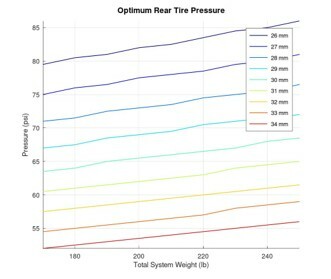
Figure 2: Rear Tire Pressure vs. System Weight and Tire Size
Getting it done
Use the following procedure to obtain reliable weight and tire size values. It requires a pair of dial calipers, a bathroom scale, and a helper:
- Inflate the tires to the value typically used.
- Measure the width across the sidewalls with a dial caliper (Figure 3).[7]
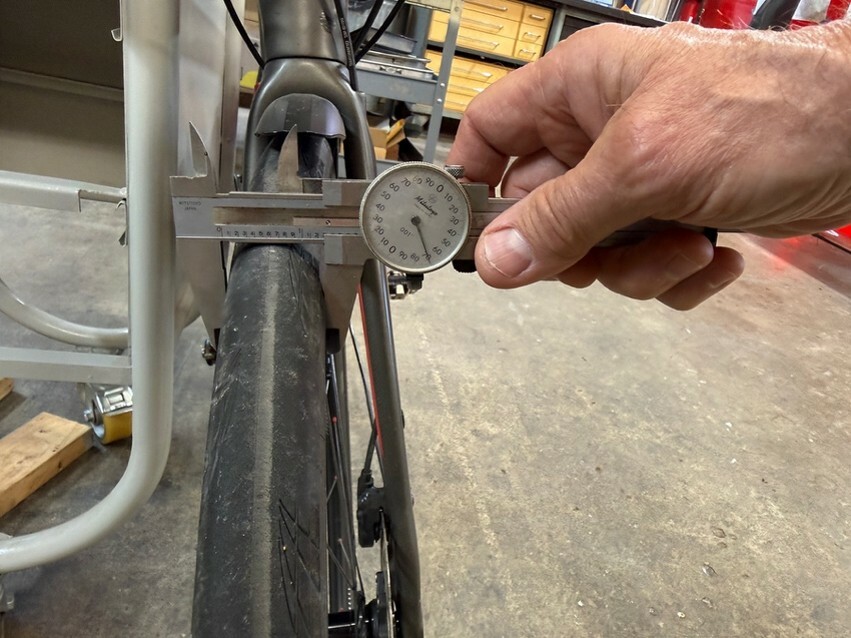
Figure 3: Measure the Tire Width
- Fit the bike with all of the typical attachments, e.g., lights, filled bottles, seat bag.
- Don your riding kit.
- Set the bike next to an object that you can use to support yourself while on the bike.
- Put a bathroom scale beneath the rear wheel.
- Mount the bike. Balance so that the scale reading is more or less steady (Figure 4).
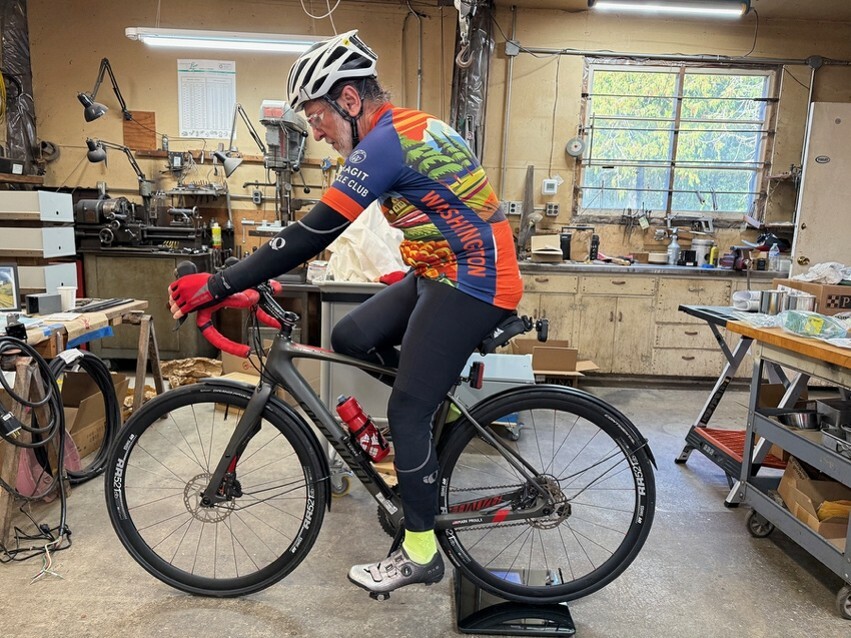
Figure 4: Weigh the Rear
- Have the helper read the weight value. In this case, the value was 119 lbf.
- Dismount the bike.
- Repeat steps 6-9 for the front wheel (Figure 5). In this case, the value was 74 lbf.
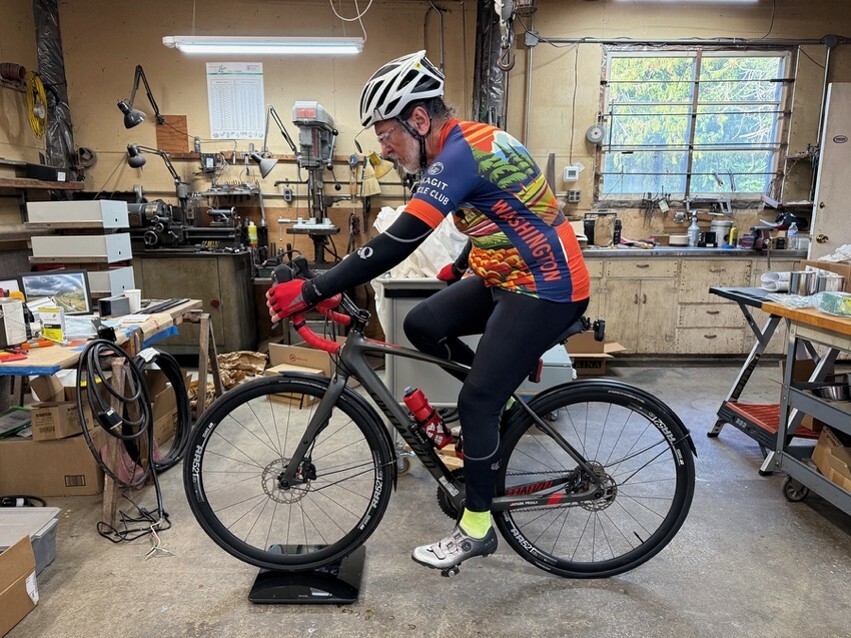
Figure 5: Weigh the Front
- Add the weight values to obtain the total system weight. In this case, the total is 198 lbf.
- Divide each weight value by the total to obtain the weight distribution. In this case, the distribution was 38/62.
- Open the tire pressure calculator.
- Set the values for the input parameters[8] and obtain the front and rear tire pressures (Figure 6). In this case, the prescribed values are 59 psi (rear) and 57 psi (front).
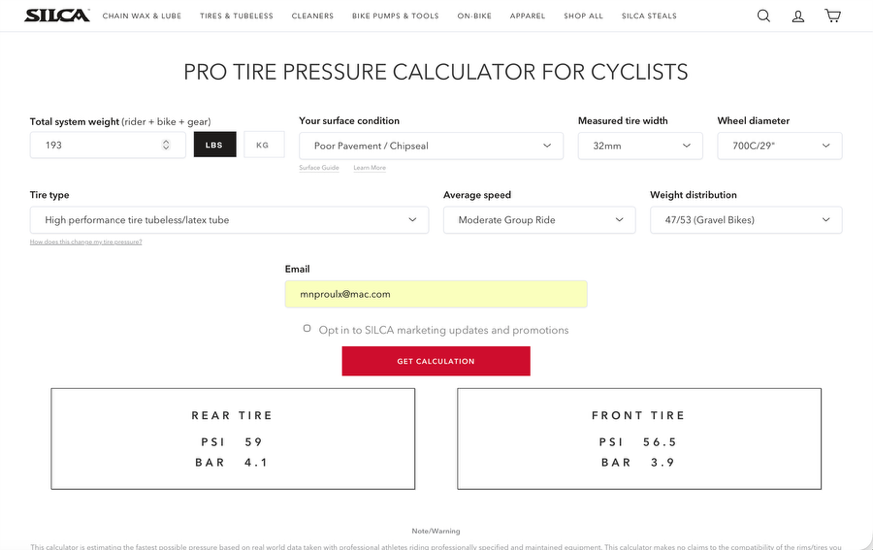
Figure 6: Tire Pressure Calculation
- Adjust the pressures to these values. Remember to treat these values as starting points. As you ride, you may wish to adjust them to improve your riding experience.
Notes
- I extracted the material in this article from these sources: Rolling Resistance (The History and Previous Works) and Rolling Resistance and Impedance by Marginal Gains Media; Suspension Losses by Jan Heine; and Blather 'bout Bikes by Tom Anhalt.
- en.wikipedia.org/wiki/Rolling_resistance
- Why anyone would overlay three curves of essentially the same color is nothing short of baffling.
- Other calculators are available; examples include one from Wolf Tooth Components and one from SRAM.
- I assumed that this selection applies to TPU tubes as well.
- The values for the front tire were consistently lower than those for the rear by 1 to 2 psi throughout the pressure and weight range.
- In this example, the width is 1.27 in, which is just a bit over 32 mm.
- Although you may have a road bike, you may find that the weight distribution you calculated in step 12 is better represented by a different bike type. In the example shown, the closest choice was for a gravel bike at 47/53.
|
|
|
Just for Laughs
 |
|
|
WELCOME, NEW MEMBERS
A hearty welcome to Carson Furry, Sarah Laudermilk, and Carol and Joe Zwick.
|
|
|
Send us news!
We need your ideas to keep this newsletter going. Email us a photo, a ride report, a poem, a link to a training or gear article: anything bike-related.
President@skagitbicycleclub.org
|
|
|
|
|